
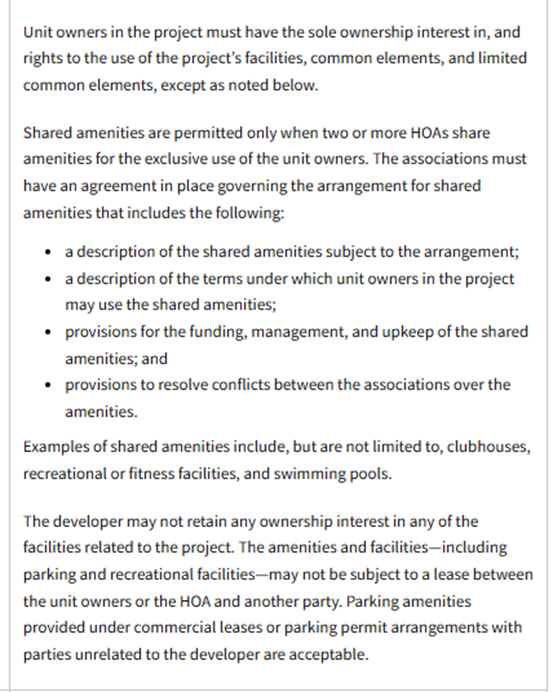
One particularly complex aspect of condo lending is handling condo projects with shared amenities—facilities like pools, clubhouses, or fitness centers that are jointly used by multiple homeowners associations (HOAs). These arrangements can enhance community appeal but also introduce compliance hurdles. I’ve included Fannie and Freddie’s direct guidelines at the bottom of this post for reference. These arrangements are not very common, but FNMA and FHLMC really don’t have an appetite for anyone having access to any amenities other than the HOA members.
Understanding Shared Amenities in Condo Projects
Shared amenities refer to common facilities that are not exclusively owned by a single HOA but are instead accessible to residents from two or more adjacent or related projects. This setup is common in large developments or master-planned communities where efficiency and cost-sharing make sense. We see these in high-density areas—particularly in Florida on the coast. For a condo project to be eligible for conventional financing, these arrangements must be carefully structured to protect unit owners' rights and ensure long-term viability.
FNMA Requirements for Condo Projects with Shared Amenities
Fannie Mae allows shared amenities under specific conditions to maintain project stability and fairness. Generally, shared amenities are permitted only between two or more HOAs, and they must be for the exclusive use of the unit owners in those projects. The project itself must be the sole owner of its amenities, with exceptions allowed for shared agreements. Key requirements include:
· Governing Agreement: The HOAs must have a formal agreement that outlines the shared amenities. This document should include a detailed description of the amenities, the terms for unit owners' usage, provisions for funding, management, and maintenance, and mechanisms for resolving disputes between the associations.
· Exclusive Use: Amenities cannot be shared with third parties like developers or commercial entities; they must be limited to residential unit owners.
· Project Eligibility Context: These rules tie into broader Full Review processes for new or established condo projects, ensuring the overall project meets criteria like completion status, owner-occupancy rates, and financial health.
Failure to meet these standards can render a project ineligible, potentially derailing loan approvals and limiting buyer options.
FHLMC Requirements for Condo Projects with Shared Amenities
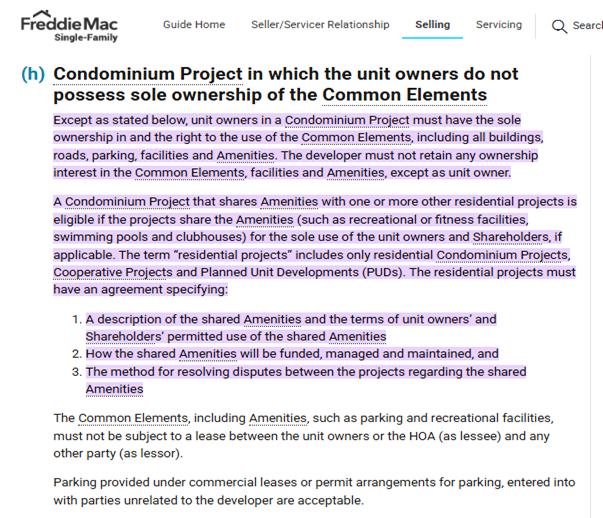
Freddie Mac's guidelines mirror FNMAs in many ways but emphasize eligibility for shared arrangements between residential projects. A condo project sharing amenities with other residential developments (like other condos, co-ops, or planned unit developments) is eligible if the amenities are for the sole use of unit owners. Recent updates have expanded this to include sharing between condos, co-ops, and PUDs, reflecting evolving market needs.
Essential elements of FHLMC's requirements include:
· Shared Agreement Specifications: The agreement must detail the amenities, terms of use for unit owners, funding and maintenance plans, and dispute resolution methods.
· Sole Ownership Principle: Unit owners must have undivided ownership of common elements, with shared facilities formalized to avoid developer retention or lease issues.
· Broader Project Standards: Like FNMA, this fits into new or established project reviews, with owner-occupancy minimums (e.g., 50% for new projects) and compliance with laws.
These rules help mitigate risks, such as uneven maintenance costs or conflicts that could affect property values.
Challenges for Lenders in Reviewing Projects with Shared Amenities
Reviewing condo projects with shared amenities can be time-consuming and complex for lenders. It involves gathering and analyzing extensive documentation, including HOA agreements, budgets, insurance policies, and legal descriptions. Errors in interpretation could lead to non-compliance, exposing lenders to repurchase demands or financial losses. Additionally, with evolving guidelines staying current is crucial. This is where expert assistance becomes invaluable.
How Condoanalytics Assists Lenders with Shared Amenity Reviews Condoanalytics (www.condoanalytics.com) specializes in simplifying these reviews, offering tailored services that ensure compliance with FNMA and FHLMC standards. As a nationwide provider, we've completed over 38,000 project reviews across all 50 states, making them a trusted partner for lenders dealing with complex scenarios like shared amenities.
Our key offerings include:
· Full Condo Reviews: This comprehensive service handles document retrieval and certification, verifying all aspects of the project, including shared amenity agreements, to confirm eligibility. For projects with shared amenities, they scrutinize the governing documents to ensure descriptions, usage terms, funding provisions, and dispute mechanisms meet agency requirements.
· Customized Options: Lenders can opt for document-provided reviews (for cost savings), limited reviews, expedited services, or targeted checks like insurance, budget, or litigation reviews. This flexibility is ideal for isolating shared amenity issues without a full overhaul.
· Recertifications and PUD Reviews: For ongoing compliance or related project types, they provide recertification to keep projects eligible amid guideline changes.
Fannie Mae’s direct guidelines on shared amenities:
Freddie Mac’s direct guidelines on shared amenities:
By outsourcing to Condoanalytics, lenders save time, reduce errors, and mitigate risk—allowing faster loan processing and more confident decision-making. Our expertise in FNMA, FHLMC, and FHA guidelines ensures that even intricate shared amenity setups are thoroughly vetted. Visit www.condoanalytics.com to learn more and elevate your condo lending strategy in 2026. Contact Nick De Santis at info@condoanalytics.com to learn more about how to partner with the professionals at Condoanalytics.
Nick De Santis, AMP
Director of Business Development, Condoanalytics